
Go beyond chatbots. Build intelligent agents.
Learn to create AI agents that can retrieve trusted information, use tools, coordinate workflows and power full-stack applications—from Python foundations through deployment.
Full-Stack Agentic AI course content
Follow a practical path from LLM applications to RAG, agent workflows, full-stack apps and production deployment. Each module pairs core concepts with a build activity.
| # | Module | Highlighted topics | Hands-on build |
|---|---|---|---|
| 01 | AI & Generative AI Foundations | AI / ML / deep learning LLMs & tokens Prompt engineering Structured outputs Tool calling and model APIs | Call an LLM API from Python and validate a structured response. |
| 02 | Python for AI Applications | Python fundamentals Functions, classes and modules; uv / pip environments async, APIs, JSON, environment variables and Git | Create a version-controlled Python project that calls an API. |
| 03 | LLM Application Development | Chat architecture, conversation history and memory; streaming tool calls, output validation, retries, timeouts, rate limits and token costs | Build a chat app with streaming and resilient error handling. |
| 04 | Retrieval-Augmented Generation (RAG) | PDF / Word / web ingestion, chunking and embeddings; vector search hybrid retrieval, reranking, citations, evaluation, access controls and prompt-injection awareness | Build and evaluate a document Q&A assistant with grounded answers. |
| 05 | LangChain | Models, prompts, chains, tools and retrievers; document loaders, output parsers and integration patterns; when to use a framework versus a direct API | Assemble a small LLM and RAG workflow. |
| 06 | Agentic AI Fundamentals | Agent loop: observe → decide → act → check planning, tools, memory, ReAct, reflection, human approvals and stop conditions | Build a bounded agent that uses tools with clear limits. |
| 07 | LangGraph | Nodes, edges & state conditional routing, checkpoints, persistent state, loops, parallel execution and resumable human approvals | Create a stateful workflow with branching and checkpointing. |
| 08 | Multi-Agent Systems | Single vs. multi-agent trade-offs; supervisor, sequential, parallel and hierarchical patterns; delegation, handoffs, shared state and coordination failures | Build a supervisor workflow that delegates to specialist agents. |
| 09 | Model Context Protocol (MCP) | MCP clients & servers tools, resources, prompts, transports, authentication and trusted, safe tool execution | Create a controlled MCP tool and connect it to an agent. |
| 10 | Agents, APIs & Enterprise Integrations | REST, FastAPI, request validation and webhooks; API keys and OAuth basics; scoped credentials, business tools, retries, idempotency and audit logs | Build a mock business API that handles repeated or failed requests safely. |
| 11 | Databases for AI Agents | SQL & PostgreSQL text-to-SQL, query validation, read-only access, query limits, authorization, vector databases and metadata | Build a read-only data assistant with controlled queries. |
| 12 | Full-Stack AI App Development | React + FastAPI HTML, CSS, JavaScript, REST, WebSockets and streaming; connect UI to LangGraph, RAG and databases; sessions and errors | Build a working web interface for an AI assistant. |
| 13 | Agent Evaluation & Observability | Repeatable test datasets; task success, retrieval & groundedness human review, traces, latency, costs, errors and tokens | Produce an evaluation report that compares a baseline and an improvement. |
| 14 | Agent Security & Guardrails | Prompt injection & jailbreaks untrusted content, data leakage, PII handling, least-privilege tools, approvals and security testing | Document and demonstrate safeguards for an agent workflow. |
| 15 | Production Deployment | Docker & Compose Linux, environment configuration, CI/CD, Azure or AWS, monitoring, secrets, rollback and Kubernetes basics | Deploy a containerized app with health checks and operational logs. |
| 16 | Capstone & Portfolio | Business problem and acceptance criteria; architecture, implementation, testing, evaluation and deployment; GitHub README & demo | Present a working end-to-end app with documentation and design trade-offs. |
The syllabus covers practical patterns and trade-offs; tools and cloud services may vary by project and batch. Ask us for current batch timings and fee details.
Projects that bring the concepts together
Learn by building and reviewing
Work through milestone projects, code reviews, demos and feedback. Put the workflow, evaluation and design decisions behind each project into a clear portfolio.
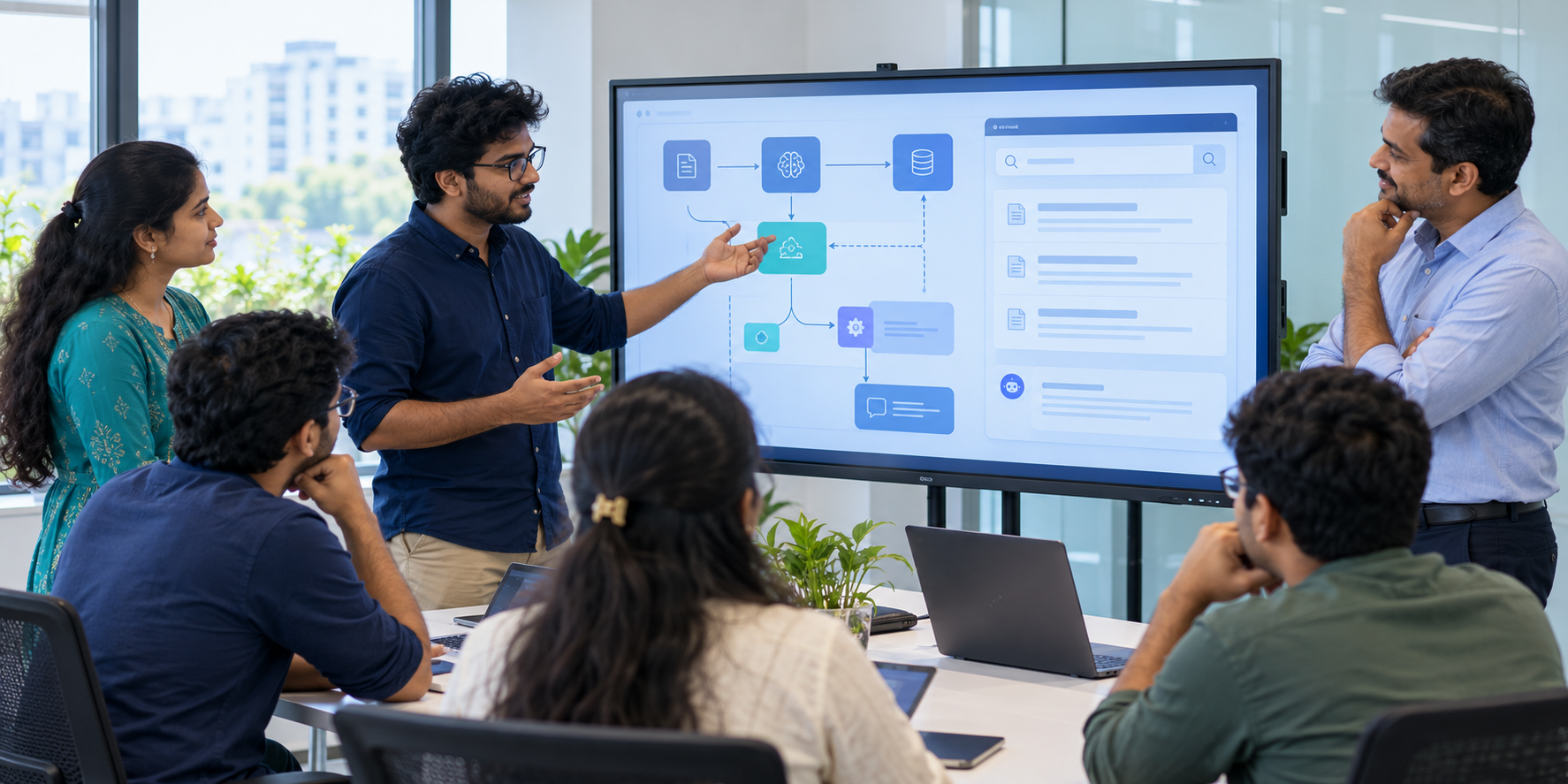
AI Research Agent
Coordinate planning, web and document research, fact checking and report generation. Track sources, claims, conflicting evidence and failure cases.
Enterprise RAG Assistant
Answer questions from controlled documents with retrieval, metadata filters, citations and insufficient-evidence handling; review access and prompt-injection risks.
Customer Support Multi-Agent
Route customer requests to specialist agents using intent routing, mock business tools and human escalation, while avoiding duplicate actions.
Full-Stack Agentic AI App
Connect React, FastAPI, LangGraph, tools or MCP, SQL and vector search with streaming UI, tests, logs and evaluation.
Explore the tools used across the program
Practice with the building blocks used to create, connect, evaluate and deploy AI agent applications.
Concepts, code, feedback and a capstone
Learn through structured practice and finish with work you can explain and demonstrate.
01 · Understand
Instructor-led concepts introduce the design choices behind LLMs, retrieval and agent workflows.
02 · Build
Code in guided labs and milestone projects, with reviews and demos to get feedback as you progress.
03 · Present
Complete a capstone, evaluate its behavior and document setup, limitations and architecture.
Portfolio deliverables: lab repository · RAG evaluation · agent workflow · security review · capstone demo
Get the syllabus and current batch details
Tell us what you want to build. We’ll share the latest course options, available batch timings, fees and learning mode. Message us on WhatsApp to request a callback or ask a question.