Demo videos on Trees
Demo videos on Linked List
Data Structures and Algorithms
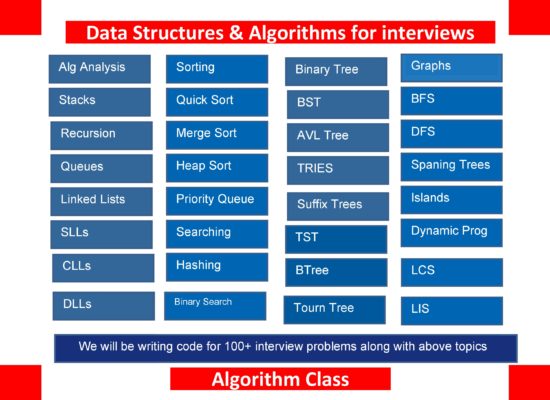
Data Structures for interviews course at Algorithm Training training institute requires prior knowledge from students on Data Structures and Algorithms. This training targets top MNC interviews. This Training would be very useful for in and off campus placements for students from IITs, NITs, BITs, IIITs, Universities and other top engineering students. Here we are going to discuss and implement the problems. Hence this is one of the Best Data structures And Algorithms Training In Bangalore or Data Structures and Algorithms Training In Hyderabad
Course Details:
Duration: 50+ hrs
time : 7.30 pm
Mode :Â Online
Course Fee:Â 400 usd
Demo:
Trainer Details:
Trainer Details:
DSA Alumni
Mr Srihari trained nearly 26 students on Data Structures and Algorithms….. He trained ppl from B.tech student to 20 years of real time experienced ppl and students  from various cities in India and Countries like USA, Australia, UK  …etc. click here for Data Structures and Algorithms old batches details
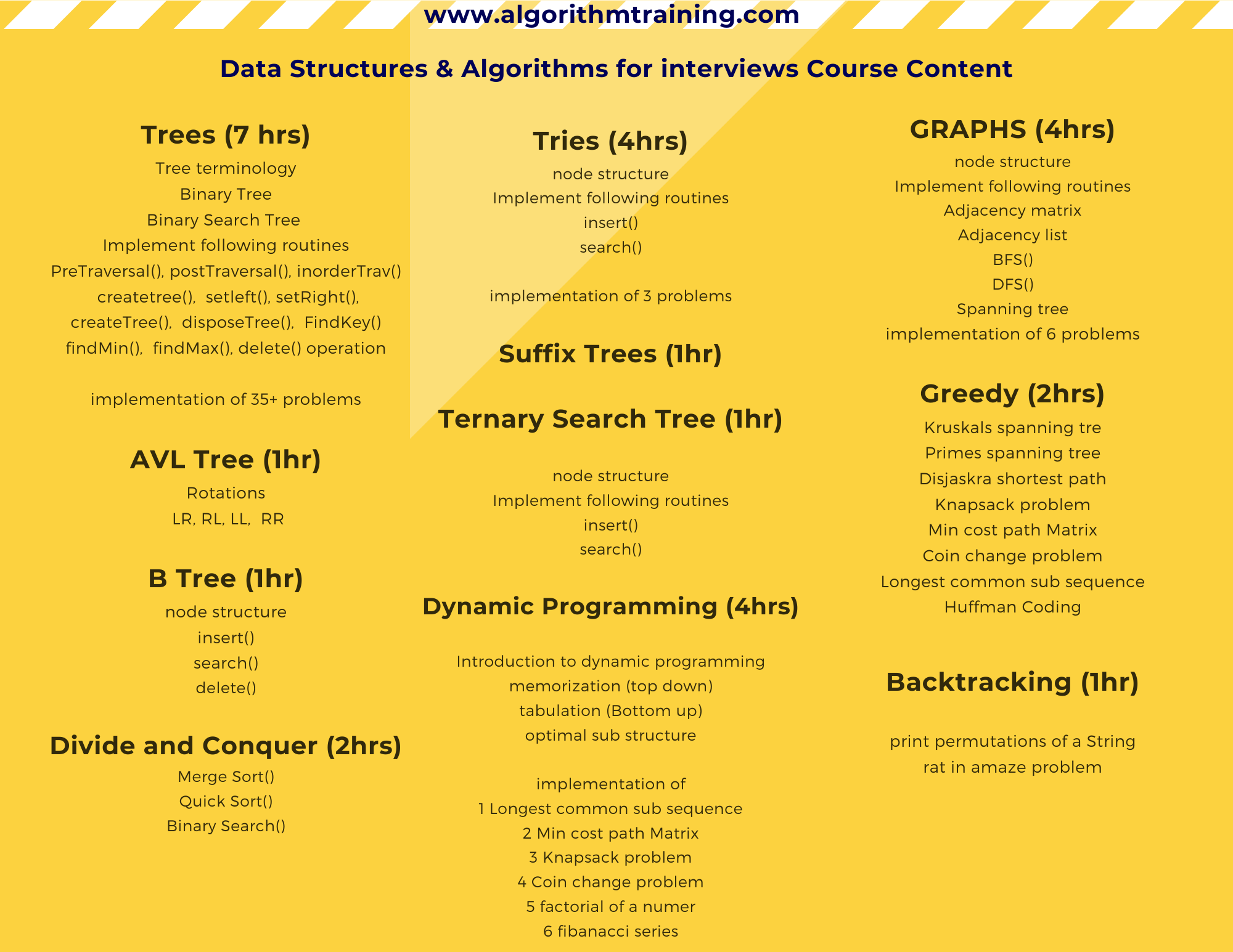
Course Content
Download course content here:
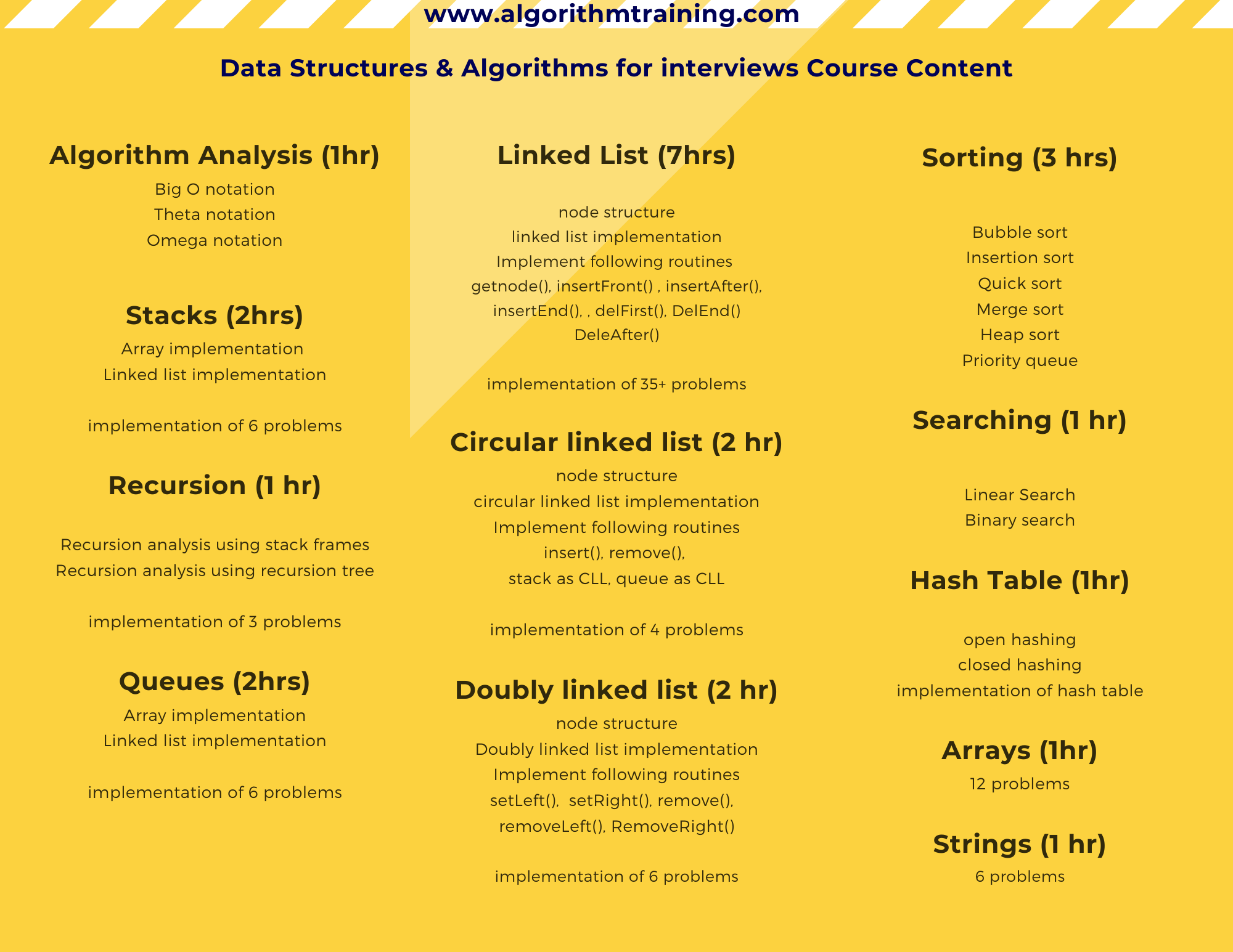
| SNO | Topic | Sub topic | Sample questions | No. of hrs |
|---|---|---|---|---|
| 1 | Algorithm Analysis | How to analyse a program
Big O notation Theta notation Omega notation |
1 | |
| 2 | Stacks | a)Array implementation
b) Linked list implementation create stack() isempty() push() pop()
|
1.Check for balanced parentheses in an expression 2, Manage 2 stacks in an array 3. Check String is palindrome or not 4. Reverse a string 5.infix to post fix conversion 6. evaluate postfix expression |
3 |
| 3 | Recursion | Recursion analysis using stack frames
Recursion analysis using recursion tree |
Analysis of factorial problem
Analysis of fib series String permutations Towers of Hanoi |
1 |
| 4 | queues | a)Array and linked list implementation of a queue
create queue() isempty() insert() remove() b) circular queue c) double ended queue |
1. Queue using 2 stacks
2. Sort queue 3. Reverse Queue ...etc |
1 |
| 5 | Linked Lists | Why linked list
linked list implementation node structure Implement following routines getnode() insertFront() insertAfter() insertEnd() DelFirst() DelEnd() DeleAfter() |
35 + problems on LL
Implementation of the following problems
 1.Insert new node at front end of linked list
   2. Delete the first node at the front of the LL
   3.Implement Stack using LL
 4. Insert at end of the linked list
5. Insert an element into sorted LL Â Â Â 6.Insert new node after the given node
   7. Delete the node with data x in LL
   8.Insert the new node after the given node
   9.Find Kth node from head in LL
   10.Find Kth node from back
   11. Swap kth node from front with kth node from back
   12.Find Middle element
   13.Find whether th ll is even length or odd length
   14.Reverse LL
   15. Print LL
   16.find length of ll
17. the Find common node in common to both the lists. 18. delete a node p given in a linked list efficiently
19 Delete kth element from last
20.Insert After Kth Node from last
21. Alternating split of a given Singly Linked List
22 check whether linked list polindrome or not
23 pair wise swap
24 delete N nodes after M nodes
25 Delete alternate nodes of a Linked List
26 Compare two LLs
27. Merge 2 sorted LLs
28. Remove duplicates in LLs
29. add two numbers stored in two LLs
30.Detect loop in LLs
|
8 |
| Â 6 | Circular linked list | insert()
remove() stack as CLL queue as CLL |
1.Implement stack using circular queue
2.implement circular queue using linked list 3.Split CLL into two halfs 4.Merge 2 CLLs into One CLL |
1 |
| Â 7 | Doubly linked list | setLeft()
setRight() remove() removeLeft() RemoveRight() |
DLL NODE structure
1.Implement insert front DLL 2.Implement delete front node 3.Delete Given Node 4.Insert After the given node 5.Insert before the given node 6.Reverse DLL
|
1 |
| 8 | Binary Tree  and Binary Search trees | a) Tree terminology
b) General tree a) expression tree b)Binary Tree e) Tree traversal PreTraversal() postTraversal() inorderTrav() f) Construct original tree from given pre order and in order traversals.
g) Construct original tree from given post order and in order traversals.
a) createtree() b) setleft() c) setRight() d) createTree() e) disposeTree() f) FindKey)_ g) findMin() h) findMax() i) find inorder successor, predecessor
j) Tree delete operation
|
35 + problems on trees
1.create tree non recursively 2. implement insert a new node into tree 3. implement find min in BST 4.implement find max in BST 5.Implement to delete all nodes in BST 6.Find the given key in BST 7.Find min node in BST 8. Find max in BST 9. Implement preorder traversal 10. Implement inorder traversal 11. Implement preorder traversal 12 implement Delete a node BST 13.Find min in BT
14.find max in BT
15.Program to find no of full nodes
16.Program to find no of single nodes
17.Program to find no of leaf nodes
18.Find if there exists a path with length K to leaf
19. Find if there exists a path with length K to given node
20.Print path sum at each node
21.Find level of the tree
22. Find level of given node
23.Find least common ancestor of p and q nodes in BT
24 Find mirror copy of the tree
25.Find Given nodes are Siblings or not
26. Find the given nodes are cosine or not
27Find both trees are identical or not
28.Remove all nodes in the given range in BST
29.Print right view of the tree
30.Find the depth of the tree
31.Find Height of the tree
32.Find inorder successor of the node
33.Find diameter of the tree
34.Sorted DLLIST to BST
35.BST to DLL
36.level order traversal of BT
37. Print in spiral order
38. Given BT Is BST or not
39.Reverse Level Order
|
10 |
| Â 9 | AVL tree |
Rotations
a) LR
b) RL
c) LL
d) RR
|
1 | |
| Â 10 | Â Sorting | Â Bubble sort
Insertion sort Quick sort Merge sort Heap sort Priority queue |
3 | |
| Â 11 | Array | 1. given a binary digits like001101 arrange the numbers such that zeroes should follow 1sike 0001111.
2. Find Triplets of a+b+c=k in an array
3. Next Greater element in an array
4.Lead element in an array
5. Arrange RGB in an array
6.Find unique nos in an array
7.Check 2 arrays are equal or not
8.K largest elements in an array
9.find x and y in an array whose sum is K
'10.Merge two sorted arrays without extra space
11. Find missing number
12. Find missing 2 numbers
|
2 | |
| 12 | Strings |
|
||
| 12 | searching | Linear Search
Binary search |
2 problems on tries
|
1 |
| 13 | Hashing | open hashing
closed hashing |
implementation of hash table
|
1 |
| 14 | Tries | introduction
node structure insert search |
2 problems on TRIES
|
2 |
| 15 | Suffix Trees | 1 | ||
| 16 | Ternary Search Tree | introduction
node structure insert search |
1 | |
| 17 | Â B tree | introduction
node structure insert (algorithm) search (algorithm) |
1 | |
| 18 | Tournament Tree | 1 | ||
| 19 | Divide and conquer |
Merge Sort
Quick Sort
Binary Search
|
1 | |
| 20 | Graphs |
Adjacency matrix
Adjacency list
BFS
DFS
Spanning tree
|
Detect Cycle in a graph
Topological sorting
check the given graph is tree or not
Find the number of islands
Find Black Shapes in a Graph
Possibility of finishing all courses with given prerequisites
Clone an Undirected Graph
Knight movement on a chess board
Longest path in an undirected tree
.. etc
|
6 |
| 21 | Greedy Method |
Kruskals spanning tre
Primes spanning tree
Disjaskra shortest path
Knapsack problem
Min cost path Matrix
Coin change problem
Longest common sub sequence
Huffman Coding
|
4 | |
| 22 | Backtracking |
print permutations of a String
rat in amaze problem
|
1 | |
| 21 | Dynamic Programming |
Introduction to dynamic programming
memorization (top down)
tabulation (Bottom up)
optimal sub structure
|
rec solDP solution of
1 Longest common sub sequence
2 Min cost path Matrix
3 Knapsack problem
4 Coin change problem
5 factorial of a numer
6 fibanacci series
7. pattern matching
8.rod cutting
|
5 |
Data Structures and Algorithms Training in Hyderabad
DSA Course for Coding Interviews, Campus Placements and Top MNC Preparation
Algorithm Training Institute offers Data Structures and Algorithms Training in Hyderabad for students, freshers and working professionals who want to prepare for coding interviews, campus placements, off-campus drives and top MNC technical rounds.
This course is designed for learners who already have basic programming knowledge and want to improve their problem-solving skills using Data Structures and Algorithms. In this training, we focus on understanding concepts, solving interview-level problems and implementing solutions using programming languages such as Python, Java and C.
Our DSA training is useful for engineering students, IIT/NIT/BITS/IIIT students, university students, freshers and experienced software professionals who want to crack coding interviews in product-based and service-based companies.
Why Learn Data Structures and Algorithms?
Data Structures and Algorithms are the foundation of programming interviews. Most top MNCs and product-based companies test candidates on problem-solving, coding logic, time complexity, space complexity and implementation skills.
This course helps you prepare for questions commonly asked in technical interviews, online coding tests, campus placements and competitive programming platforms.
By learning DSA properly, you can improve:
- Coding interview problem-solving
- Logical thinking
- Program design
- Time and space complexity analysis
- Implementation skills
- Confidence for technical interviews
- Preparation for MNC placement rounds
Course Highlights
- Data Structures and Algorithms training for interviews
- Interview-oriented problem-solving approach
- Implementation-based learning
- Python, Java and C-based examples
- Online training available
- 50+ hours of training
- 7:30 PM batch timing
- Free demo class available
- Suitable for campus and off-campus placements
- Useful for top MNC interview preparation
- Training by an IITian trainer with industry experience
Trainer Details
Trainer: Mr. Srihari
Qualification: M.Tech CSE, IIT Roorkee
Experience: 20+ years of software experience in Data Structures, C, C++, Java, Python, Perl, Unix and parallel programming.
The trainer focuses on practical implementation, interview-level discussion and step-by-step explanation of DSA problems.
Who Should Join This DSA Course?
This course is suitable for:
- B.Tech students preparing for placements
- MCA and M.Tech students
- Freshers preparing for coding interviews
- Working professionals preparing for MNC interviews
- Students from IITs, NITs, BITS, IIITs and universities
- Candidates preparing for product-based company interviews
- Learners who want to improve problem-solving skills
- Programmers who want to strengthen Data Structures and Algorithms
Prerequisites
Students should have basic programming knowledge before joining this course. Prior exposure to any one programming language such as C, C++, Java or Python is recommended.
This course is not only theory-based. We discuss concepts and then implement problems so that students can understand how to apply DSA in real coding interviews.
Data Structures and Algorithms Course Content
1. Algorithm Analysis
- Time complexity
- Space complexity
- Big O notation
- Theta notation
- Omega notation
- How to analyse a program
2. Stacks
- Stack using arrays
- Stack using linked lists
- Push and pop operations
- Balanced parentheses problem
- Reverse a string
- Infix to postfix conversion
- Postfix expression evaluation
3. Recursion
- Recursion using stack frames
- Recursion tree analysis
- Factorial problem
- Fibonacci series
- String permutations
- Towers of Hanoi
4. Queues
- Queue using arrays
- Queue using linked lists
- Circular queue
- Double-ended queue
- Queue using two stacks
- Reverse queue
- Sort queue
5. Linked Lists
- Singly linked list
- Node structure
- Insert at front
- Insert at end
- Insert after a given node
- Delete first node
- Delete last node
- Delete a node by value
- Reverse linked list
- Find middle element
- Detect loop in linked list
- Merge two sorted linked lists
- Remove duplicates
- Add two numbers using linked lists
6. Circular Linked List
- Insert operation
- Remove operation
- Stack using circular linked list
- Queue using circular linked list
- Split circular linked list
- Merge circular linked lists
7. Doubly Linked List
- Doubly linked list node structure
- Insert front
- Delete front node
- Delete given node
- Insert before a node
- Insert after a node
- Reverse doubly linked list
8. Binary Trees and Binary Search Trees
- Tree terminology
- Binary tree
- Binary search tree
- Tree traversal
- Preorder traversal
- Inorder traversal
- Postorder traversal
- Construct tree from traversal data
- Find minimum and maximum
- Delete node in BST
- Inorder successor and predecessor
- Level order traversal
- Diameter of tree
- Height and depth of tree
- Check whether a binary tree is BST
- Lowest common ancestor
- Mirror tree
- Right view of tree
- Spiral order traversal
9. AVL Trees
- AVL tree introduction
- Rotations
- LL rotation
- RR rotation
- LR rotation
- RL rotation
10. Sorting Algorithms
- Bubble sort
- Insertion sort
- Quick sort
- Merge sort
- Heap sort
- Priority queue
11. Arrays
- Find triplets with given sum
- Next greater element
- Leaders in an array
- Arrange RGB values
- Find unique numbers
- Check whether two arrays are equal
- Find K largest elements
- Find pair with given sum
- Merge two sorted arrays
- Find missing number
- Find two missing numbers
12. Strings
- Reverse a string
- String permutations
- Longest common subsequence
- Longest increasing subsequence
- Find a word in dictionary
- Common prefix problems
13. Searching
- Linear search
- Binary search
- Search in sorted array with duplicates
- Find first occurrence
- Find lowest index of an element
14. Hashing and Tries
- Hash table implementation
- Open hashing
- Closed hashing
- Trie node structure
- Trie insert
- Trie search
- Trie-based interview problems
15. Graphs
- Graph representation
- Adjacency matrix
- Adjacency list
- BFS
- DFS
- Spanning tree
- Cycle detection
- Topological sorting
- Check whether graph is a tree
- Number of islands problem
- Clone an undirected graph
- Knight movement problem
- Longest path in an undirected tree
16. Greedy Algorithms
- Kruskal’s algorithm
- Prim’s algorithm
- Dijkstra’s shortest path
- Knapsack problem
- Minimum cost path
- Coin change problem
- Huffman coding
17. Backtracking
- Print permutations of a string
- Rat in a maze problem
- Backtracking problem-solving approach
18. Dynamic Programming
- Introduction to dynamic programming
- Memoization
- Tabulation
- Optimal substructure
- Longest common subsequence
- Minimum cost path
- Knapsack problem
- Coin change problem
- Fibonacci series
- Pattern matching
- Rod cutting problem
How This Course Helps in MNC Interviews
This Data Structures and Algorithms course is designed to help students understand how to approach interview problems. Instead of only memorizing theory, students learn how to think, analyse and implement solutions.
You will learn how to:
- Understand the problem statement
- Choose the right data structure
- Analyse time and space complexity
- Write clean logic
- Dry run the solution
- Implement the solution in code
- Handle edge cases
- Explain the approach in interviews
How to Prepare for Top MNC Interviews?
To prepare for top MNC interviews, you should build a strong foundation in Data Structures and Algorithms. Start with arrays, strings, linked lists, stacks and queues. Then move to trees, graphs, sorting, searching, recursion, greedy algorithms and dynamic programming.
Practice implementation regularly. Focus on understanding why a solution works, not only on memorizing answers. Interviewers usually check your approach, problem-solving clarity, coding ability and complexity analysis.
How to Crack Coding Interviews?
To crack coding interviews, you need regular practice and a structured learning path. Learn each data structure, solve related problems and revise frequently. Practise explaining your solution clearly because communication is also important in technical interviews.
This course helps students prepare for coding rounds, technical interviews and placement tests through implementation-based DSA training.
Course Details
Course Name: Data Structures and Algorithms for Interviews
Mode: Online
Duration: 50+ hours
Batch Timing: 7:30 PM
Demo Class: Available
Fee: Contact for current fee details
Location: Hyderabad
Institute: Algorithm Training Institute
Contact for DSA Training in Hyderabad
To join the Data Structures and Algorithms training in Hyderabad, contact Algorithm Training Institute for syllabus, demo class, fee details and batch timing.
Website: https://algorithmtraining.com/data-structures-and-algorithms-training-in-hyderabad/
WhatsApp: +91-9963930865
Email: algorithm.class@gmail.com
Address: 204, Nandini Residency, Addagutta, KPHB, Hyderabad
Frequently Asked Questions
What is the best Data Structures and Algorithms training in Hyderabad?
Algorithm Training Institute offers interview-oriented Data Structures and Algorithms training in Hyderabad with practical implementation, problem-solving practice and MNC interview preparation.
Is this DSA course useful for campus placements?
Yes. This course is useful for students preparing for campus placements, off-campus drives and technical interviews.
Which programming languages are used in this DSA course?
The course explains Data Structures and Algorithms with implementation using programming languages such as Python, Java and C.
Do I need programming knowledge before joining?
Yes. Basic programming knowledge is recommended because this course focuses on interview-level DSA problems and implementation.
Is online training available?
Yes. Online Data Structures and Algorithms training is available.
Will this course help for MNC interviews?
Yes. The course is designed for students and professionals preparing for top MNC coding interviews and technical rounds.
What topics are covered in this DSA course?
The course covers algorithm analysis, stacks, queues, recursion, linked lists, trees, sorting, arrays, strings, searching, hashing, tries, graphs, greedy algorithms, backtracking and dynamic programming.
How can I join the demo class?
You can contact Algorithm Training Institute through WhatsApp or the enquiry form on this page to get demo class details.